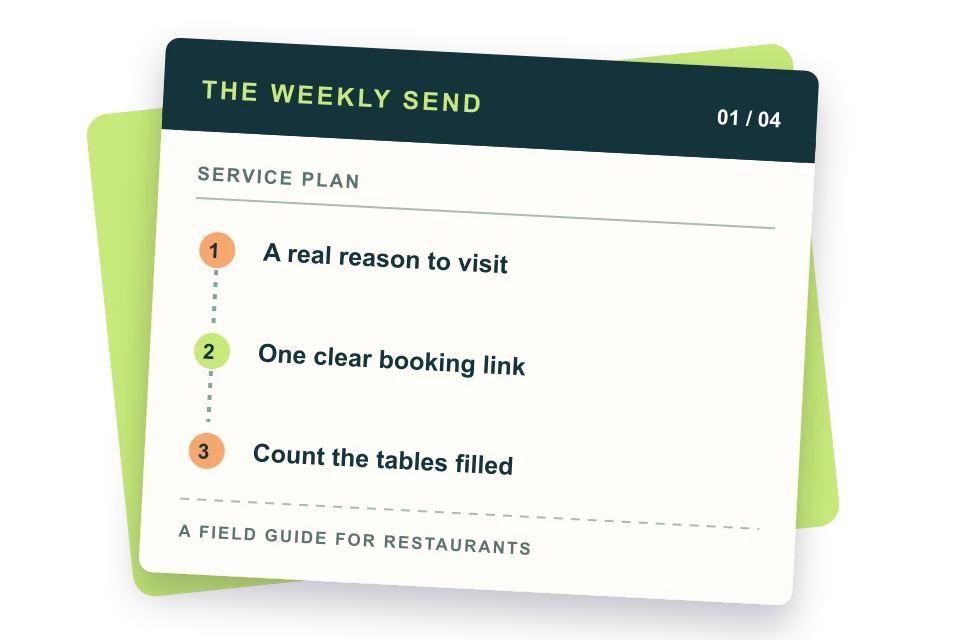
The strongest restaurant email ideas start with a real reason to visit: a new dish, an open table, a limited event, a birthday, or an earned reward. Match each idea to one guest group, one send moment, and one booking or ordering action. The subject lines and timing below are editable starting points, followed by publicly documented restaurant examples.
TL;DR
- Choose an email by the business goal: first visit, slow service, repeat visit, event, or feedback.
- Every idea below includes a suggested send time, subject, and one action; timing is our estimate unless sourced.
- Use a real menu item, date, price, location, and availability before sending sample copy.
- Do not send a loyalty balance or “last visit” claim unless your POS data supports it.
- Track bookings, orders, and redemption alongside clicks, then keep the ideas that work for your guests.
- Real brand examples are linked to vendor case studies and identified as such.
Ideas 1–5: turn new subscribers into first visits
New subscribers have shown interest, but many have not tasted the food. Help them picture a visit and choose a next step. Lead with a specific dish, service, or table rather than a long generic brand story. The following send windows are our editorial starting points.
| Idea | Suggested time | Subject line to adapt | Action |
|---|---|---|---|
| 1. A simple welcome | Immediately after opt-in | “Welcome to [Restaurant]. Start here.” | View the menu |
| 2. The signature dish | 2–4 days after welcome | “The [dish] our regulars come back for.” | See dish and hours |
| 3. A first-visit guide | Within the first week | “First time at [Restaurant]? Here’s the short version.” | Book a table |
| 4. Neighborhood lunch | Before a weekday lunch | “Lunch near [landmark], without the guesswork.” | Order ahead |
| 5. Meet the team | After a useful first message | “Meet the person behind [dish].” | Explore the menu |
For idea 1, deliver exactly what the signup promised. If the table card offered a first booking reward, include the code and terms in the welcome message. For idea 2, use a menu item that is reliably available and write one sensory or practical detail. “Our hand-folded dumplings are made each morning” says more than “delicious food,” but only if it is true.
Idea 3 can answer the hesitation a first-time guest has: whether to book, where to park, what the price range is, and whether the room welcomes children. A short first-visit guide is especially useful for a destination restaurant. For a quick-service counter, idea 4 may be stronger because a direct preorder link removes the wait.
Ideas 6–10: fill quiet services and sell available inventory
Quiet services need precision. A broad discount can shift visits you would have earned anyway. Start with real availability and a reason that fits the service: a fixed-price lunch, an early seating, a chef’s counter slot, or a new dish that works on a weeknight. Stop a scarcity email when the seats are gone.
| Idea | Suggested time | Subject line to adapt | Action |
|---|---|---|---|
| 6. The open Tuesday | 2–3 days before | “Tuesday dinner has room for [dish].” | Book Tuesday |
| 7. Early seating | 3–5 days before | “An early table, the full menu.” | See early times |
| 8. Rainy-day comfort dish | Only with reliable local forecast | “Rain outside, [dish] inside.” | Order pickup |
| 9. Midweek family meal | Before the week begins | “Dinner for the whole table on Wednesday.” | See the family menu |
| 10. Same-week private table | When a real opening appears | “A group table opened for [date].” | Ask about the space |
For idea 6, target guests who have visited on that weekday if you can trust the data. State the exact service hours and link directly to the date in the booking system. For idea 7, make the early seating appealing on its own: easier parking, a quiet room, or enough time to reach a show nearby. Do not imply a benefit your restaurant cannot deliver.
Weather-based copy can be charming but brittle. A forecast can change, and a national list may include guests in a different climate. Use idea 8 only when the audience is local and a manager can cancel the send. Otherwise, a straightforward “takeout tonight” message will age better.
Ideas 11–15: bring past guests back for a clear reason
A past guest does not need another introduction. Show what is new or relevant since their last visit. Use purchase and visit data carefully: if the system only records online orders, do not assume the person has not dined in. These ideas work best with trustworthy event data and suppression after a new booking.
| Idea | Suggested time | Subject line to adapt | Action |
|---|---|---|---|
| 11. The menu return | When a requested dish returns | “[Dish] is back this week.” | See menu |
| 12. Earned loyalty reward | When reward is actually available | “Your [reward] is ready to use.” | View reward terms |
| 13. Birthday plan | 7–10 days before birthday | “Birthday plans? We have [real offer].” | Book a table |
| 14. The new lunch service | After launch date is confirmed | “Lunch starts at [Restaurant] on [day].” | See lunch hours |
| 15. Lapsed-guest update | After a tested inactivity window | “New since your last visit: [dish].” | View what’s new |
Idea 11 is particularly effective when the restaurant has heard guests ask for a dish. Avoid saying “back by popular demand” without evidence. Say that the dish returns and when it is available. Idea 12 should link to a live reward page and include any expiry or exclusions, so a cashier is not surprised by an old email.
For birthdays, allow time to plan with friends. An offer that expires on the exact birth date may be inconvenient. If the business cannot guarantee a complimentary dessert at every location, do not put it in the subject. Keep the term simple enough for both guest and staff to understand.
A lapsed-guest message should use one concrete update rather than a guilt trip. If the platform cannot identify a return visit across dine-in and takeout, choose a neutral segment such as people who have not clicked or ordered online recently, and avoid claiming to know all of their visits.
Ideas 16–19: sell events and shared occasions
Events give an email a natural deadline, but details matter. Include the date, time, price, seat count where relevant, address, cancellation policy, and what is included. Send an early invitation while guests can arrange childcare or a group, then a reminder only if seats remain.
| Idea | Suggested time | Subject line to adapt | Action |
|---|---|---|---|
| 16. Tasting menu | 2–3 weeks before | “[Date]: a tasting of [theme] at [Restaurant].” | Reserve seats |
| 17. Holiday booking | When the booking window opens | “[Holiday] tables are open.” | Choose a time |
| 18. Local collaboration | After partner details are final | “[Restaurant] × [partner]: one night together.” | See event menu |
| 19. Private dining | Before planning season | “A room for your [occasion] gathering.” | Ask for availability |
A tasting email can show the menu arc without reproducing every course in a dense image. Write the theme and the reservation price as text so it works on a phone and in an inbox that blocks images. A collaboration email should explain what each partner contributes and link to a single booking page.
Holiday messages should match actual demand. A restaurant whose Mother’s Day brunch sells out early may need a longer lead time than a neighborhood weeknight special. Look at prior booking curves and test the first announcement date. A second email can go only to people who have not booked and while real space remains.
Ideas 20–21: learn from guests and protect trust
A good restaurant list is a relationship, not a coupon queue. Ask for feedback when someone has a fresh experience, and show that you acted on it. These two ideas can improve service as well as future campaign relevance.
| Idea | Suggested time | Subject line to adapt | Action |
|---|---|---|---|
| 20. Post-visit feedback | 1–2 days after a confirmed visit | “How was dinner at [Restaurant]?” | Answer a short survey |
| 21. Preference check | After several varied campaigns | “What should we send you next?” | Choose menu, events, or offers |
Keep the feedback form short and route a serious service complaint to a person. If a guest reports a problem, a generic promotional follow-up can feel careless. Use the preference email to reduce irrelevant sends: a lunch regular may want weekday specials but not late-night events.
Real brand examples and what to copy from them
Oscar’s Authentic Mexican Grill uses email reminders about double-point days, according to Toast’s case study. The transferable idea is 12, an earned or timed loyalty benefit connected to a quiet service. The vendor reports business results for this one restaurant; do not use those figures as a forecast.
Chicago Bagel Authority uses automated email campaigns tied to its Toast operations. Its published customer story reports 300 repeat visits. The transferable idea is 15: send a relevant return invitation when a reliable trigger says a guest may be ready. Count the resulting visit, not only the email open.
Chef Zhao uses guest information from its Toast directory for email and SMS messages about dishes and promotions, as described in Toast’s customer profile. The transferable idea is 11: name a real dish and connect the message to the ordering route. Verify the recipient’s permission for each channel first.
Emma’s restaurant inspiration guide illustrates additional creative directions, including welcome, birthday, and weather-related messaging. Use the inspiration as a visual reference, then add the missing operational details: trigger, exact copy, offer terms, booking path, and measurement. The main restaurant email playbook includes a complete send calendar.
Turn an idea into a measured campaign
Before writing, state the goal in one sentence: “Fill six open Tuesday tables” or “Introduce the new lunch service to nearby guests.” Those are example goals, not expected results. Choose the segment whose history makes the message relevant. Then write the subject, offer, and button around that one action.
| Field | Fill in before sending |
|---|---|
| Guest group | Who should receive this, and who must be suppressed? |
| Real-world reason | What changed in the menu, room, event calendar, or reward? |
| Send moment | Why does this day make sense for the decision? |
| Action | Which booking, ordering, or reply link will be used? |
| Result | Which confirmed visits, orders, or inquiries will be counted? |
Proofread the campaign on a phone and follow the button all the way through booking or payment. Check the sender name, preview text, menu price, date, location, accessibility of the image, and offer terms. A well-written email with a broken booking path still fails the guest.
For more on platform choice, compare restaurant email software. If a time-sensitive offer would work better on a phone, read SMS marketing for restaurants and build a separate text consent list.
Frequently asked questions
What should a restaurant put in its first marketing email?
Deliver the exact signup promise, identify the restaurant, show one useful menu or booking path, and explain what future emails will contain. If a reward was promised, include the code and terms immediately.
What restaurant email ideas work without discounts?
Try a dish return, new lunch hours, a chef’s short note, a real event invitation, an early seating, or useful first-visit information. Give each one a direct booking or ordering action so you can measure it.
How do I promote a slow restaurant night by email?
Choose the service that needs demand, target guests likely to enjoy it, give a specific reason to come, and link directly to that date. Check inventory and staffing before scheduling. Measure seated covers and margin rather than opens alone.
Can I automate restaurant birthday emails?
Yes, if guests provided birthday information for that purpose and your platform can trigger the message accurately. Send with enough time to plan, state the offer terms, and make sure staff at every location can honor it.
How do I know which restaurant email idea worked?
Use tagged booking links, order links, or a trackable offer code. Compare confirmed visits and orders with the campaign audience and cost. Write down other promotions and local events that could affect the result.